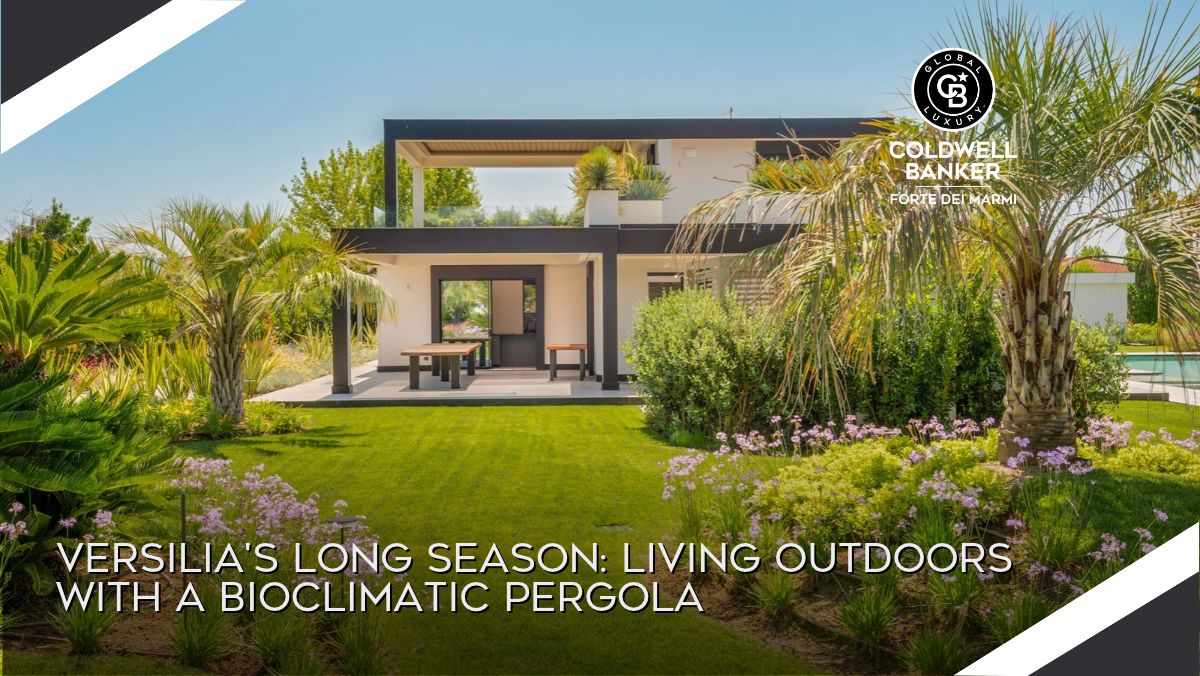
Versilia’s Long Season: Living Outdoors with a Bioclimatic Pergola
Those who only know Versilia in summer find it hard to believe, but those who live here know it well: in late October, on a sunny day, lunch is still served outdoors. The light is lower and golden, the air is mild, and the Apuan Alps stand out more sharply than at any other time of year. This is Versilia’s long season, the one that begins with the first mild days of spring and stretches well beyond the end of summer.
There is, however, one condition for truly living this season: the house must be designed for it. And this is where one of the most appreciated elements of contemporary residential architecture comes in: the bioclimatic pergola, known in the US as a louvered pergola.
The old limitation: outdoor spaces designed only for summer
For decades, a villa’s outdoor space was designed around two months: July and August. Umbrellas, awnings, a portico for shelter from the heat. Perfect solutions for high summer, far less so for the rest of the year. A windy day, an uncertain sky, the lower autumn sun, and the garden goes back to being something you look at through the windows.
The result is a paradox: precisely in the months when Versilia is at its quietest and most luminous, many villas are lived only indoors.
What a bioclimatic pergola is, and why it changes everything
A bioclimatic pergola is an outdoor cover with adjustable louvers that open, close and tilt to regulate light, shade and ventilation. It is not an awning and it is not a fixed roof: it is a structure that adapts to the weather of the moment.
In summer, the louvers are angled to create cool shade while letting the air circulate. In autumn and spring, they open to let the sun in, when warmth is a pleasure rather than a burden. If rain arrives, they close, and the space beneath stays dry and usable. In the evening, with integrated lighting, the pergola becomes an outdoor room.
In other words, it turns a terrace or a poolside from a seasonal space into a living space for much of the year.
The extra room that square meters do not count
When people evaluate a villa, they look at the interior surface, the number of bedrooms, the garden. But there is a value that appears on no floor plan: how many days a year the house allows you to live outdoors.
A well-designed bioclimatic pergola effectively adds a room to the villa: a place for lunches and dinners, for reading in the shelter of the louvers, for working on a laptop in front of the greenery, for welcoming guests when the air turns cool. And it does so without closing off the relationship with the landscape, which remains the true luxury of a home in Versilia.
For those who live in the villa beyond the summer, or are considering making it their main residence, the difference is measured in months. This is why it is increasingly appreciated by buyers, Italian and international alike, and increasingly integrated from the design stage in contemporary villas.
A concrete example: the contemporary villa in Pietrasanta
In Pietrasanta, a few minutes from the beaches and from Forte dei Marmi, our agency exclusively represents a newly built contemporary villa in which the bioclimatic pergola is not an add-on, but part of the design of the house.
On the ground floor, the large living room opens through full-height sliding glass walls onto the pool on one side and onto a bioclimatic pergola on the other. The pool, the scenic focal point of the property, is framed by two pergolas: one devoted to entertaining, with the barbecue area, the other to relaxing by the water. On the first floor, the master suite opens onto a panoramic terrace where another bioclimatic pergola frames the view of the Apuan Alps. The property is completed by a covered portico opening onto the garden of Mediterranean plants and a guest house with its own pergola.
It is a house built to be lived outdoors for as long as possible. To learn more, you can view the full details of the villa and request a private viewing.
A November day, inside and out
Picture a late-autumn day in this villa. Breakfast on the master suite terrace, with the louvers open to let in the first sun and the Apuan Alps ahead. Lunch under the poolside pergola, with the light filtering through the louvers. An afternoon of reading or working outdoors, for as long as the sun allows.
And when the evening turns cool, the villa offers the other half of the day: an entire floor dedicated to wellbeing, with sauna, Turkish bath and hydromassage, which we described in our article on the villa with spa in Versilia. Outside while the sun shines, inside when the cool arrives: the rhythm of a house that knows no dead months.
A quality that belongs to the design
Like many of the features that set a contemporary villa apart, the bioclimatic pergola works best when it is born together with the house: integrated into the spaces, the circulation, the relationship between inside and out. It is one of the reasons why, as we explained in our piece on the contemporary villa in Versilia, new design builds are among the rarest and most sought-after assets in the area. And it fits the quiet luxury between the sea and the Apuan Alps that makes Pietrasanta one of the most desirable places in Versilia.