
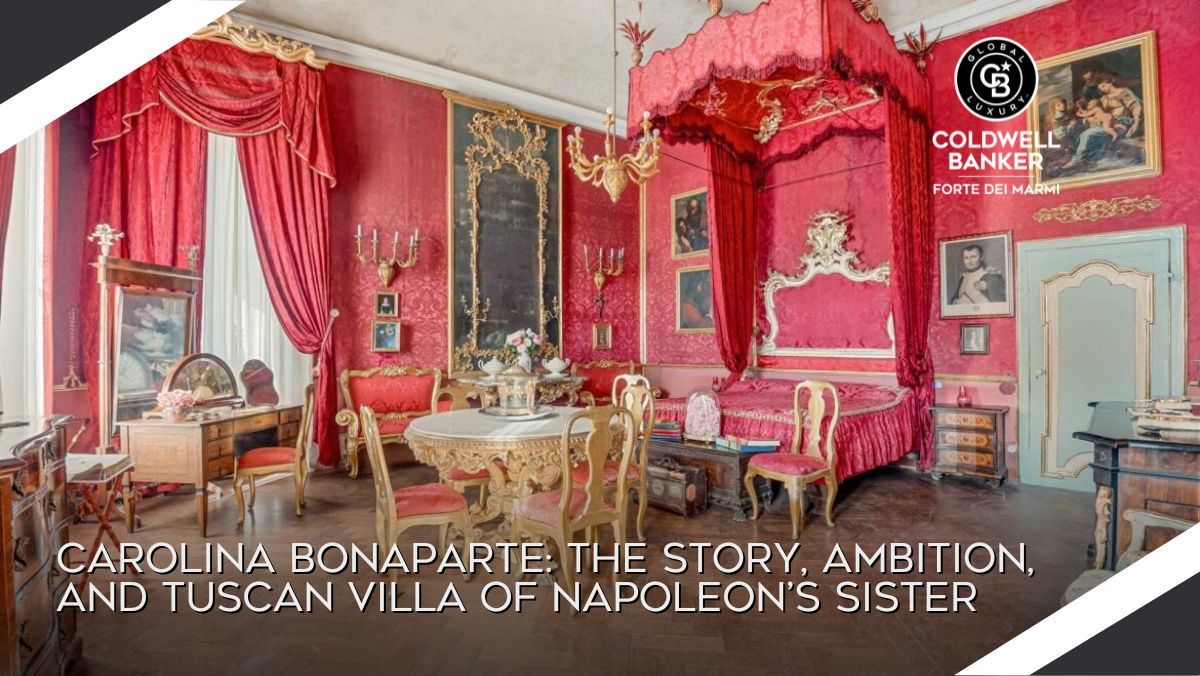
Carolina Bonaparte’s villa for sale: history and beauty in the Lucca hills
When speaking of the Bonaparte family, history tends to focus almost exclusively on the towering figure of Napoleon. However, surrounding him was a dynasty of strong and ambitious personalities, among whom Carolina Bonaparte stands out—perhaps the most determined and politically astute of the Emperor’s sisters.
From Corsican origins to Parisian salons
Born in Ajaccio on March 25, 1782, Carolina was the youngest child of Carlo and Letizia Bonaparte. Raised in a family driven by pride and social ambition, she was soon projected into the world of politics and high French society, especially after her brother’s rise to power.
Unlike many women of her time, Carolina was not content with a decorative role: she sought power and learned how to wield it skillfully.
Marriage to Joachim Murat: love and strategy
In 1800, she married Joachim Murat, one of Napoleon’s most brilliant generals. Their union was both an affair of the heart and a political strategy: Carolina saw in Murat the means to carve out her own place in the great game of European power.
In 1808, when Murat was appointed King of Naples, Carolina became queen. From that moment, she began to play an active role in the governance of the kingdom.
A modern and ambitious queen
Carolina was far from a passive sovereign. She promoted reforms, supported cultural development, and encouraged archaeological research, contributing to the rediscovery of the ancient sites of Pompeii and Herculaneum. Not infrequently, her political choices clashed with the will of Napoleon himself—and even with that of her husband.
Her figure emerged as that of a powerful woman in an age dominated by men, capable of building alliances, protecting family interests, and defending her position even in the most difficult moments.
Downfall and exile
Napoleon’s defeat also brought down Murat, who was executed in 1815. From then on, Carolina lived a long and dignified exile between Trieste, Vienna, and later Florence—under false identities and with limited means, but never abandoning her pride.
She died in Florence in 1839, leaving behind the image of a controversial, intelligent, and resolute queen.
Carolina Bonaparte’s historic villa in the hills of Lucca
Nestled among the gentle hills of Capannori (Lammari district) in the province of Lucca, this 18th-century villa, originally dating back to the 16th century and transformed into its current form in the 1700s, was once the residence of the Emperor’s sister.
The property extends over approximately 4,250 m² across five floors, featuring 20 bedrooms, 10 bathrooms, and a private garden on a plot surrounding the villa, all set within about 6 hectares of land.
The interiors are of great prestige: on the main floor, a magnificent double salon of 125 m² stands out, adorned with 18th-century stuccoes and paintings attributed to Pier Dandini — “The Battle of the Milvian Bridge” and “The Rape of the Sabine Women.”
The estate also includes an independent guesthouse (~300 m²) finely restored, historic stables and a caretaker’s house (~1,150 m²), a historic lemon house (~300 m²), and two swimming pools set within the Italian-style gardens.
This luxury villa is a true cultural treasure: its historic architecture, period decorations, Tuscan landscape, and direct connection to Carolina Bonaparte make it a unique property for those seeking beauty, history, and exclusivity.
A woman ahead of her time
Carolina Bonaparte remains a fascinating figure—ambitious, political, and modern in an age when women were granted little influence in matters of state. Her fate is inextricably linked to that of her imperial brother, but her personal story deserves to be known and celebrated.
Carolina was a true protagonist of her era: a woman who sought to exercise power with the same determination as the men around her, leaving a mark on European history.
CLICK HERE TO SEE CAROLINA BONAPARTE’S VILLA FOR SALE IN CAPANNORI-LAMMARI (Lucca)