
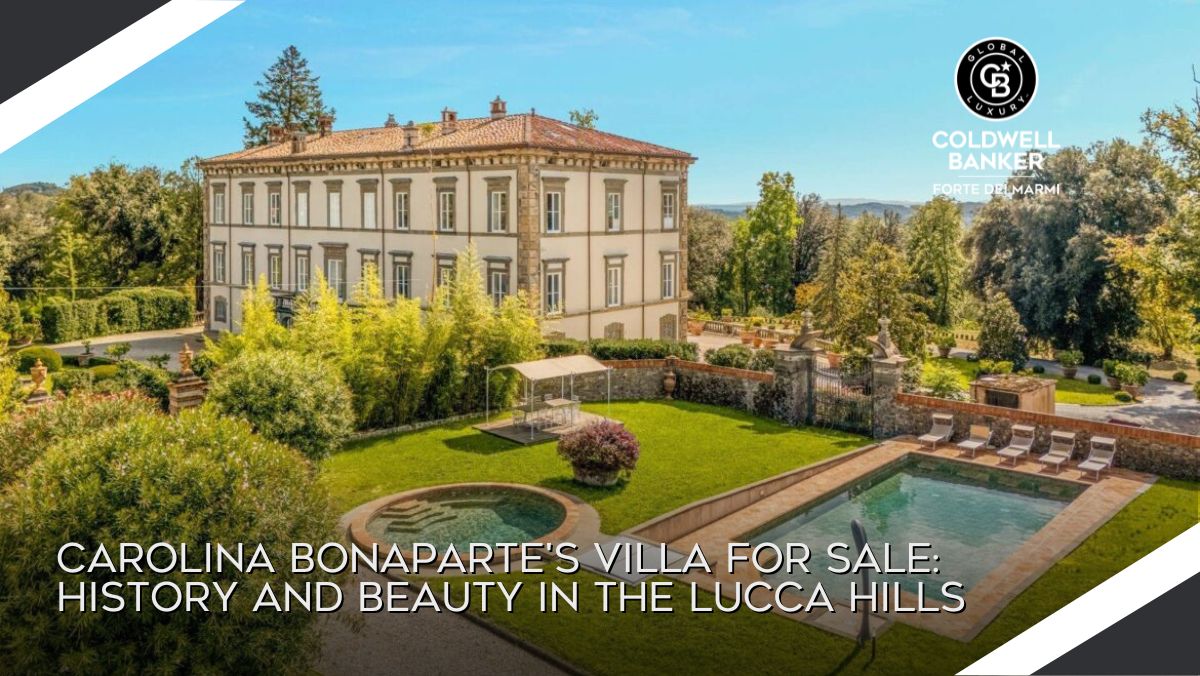
Carolina Bonaparte’s villa for sale: history and beauty in the Lucca hills
On the gentle hills surrounding Lucca, where the Tuscan countryside reveals its most authentic charm, stands a residence that belongs to both history and legend: the Villa of Carolina Bonaparte, sister of Napoleon and Queen of Naples. A timeless place where art, memory, and beauty intertwine in a story that spans centuries of elegance and culture.
The origins of the estate date back to the 16th century, but it was in the 18th century that the villa took on its current form, when Coriolano Orsucci, a member of a noble Lucchese family, transformed it into a true residence of delight. The enlargement and embellishment project was entrusted to the Baroque architect Filippo Juvarra, who also designed the monumental gate of the walled garden — a masterpiece of balance and refinement. In 1836, the estate was purchased by Carolina Bonaparte, who chose it as her private retreat, far from the noise of the court but rich in sophistication and intellectual life.
Inside, the villa still tells the grandeur of its era. The more than 2,500 square meters unfold across several levels, dominated on the piano nobile by a 125-square-meter double-height hall, adorned with sumptuous 18th-century stuccoes and illuminated by two grand canvases attributed to Pier Dandini: The Battle of Ponte Milvio and The Rape of the Sabines. It is said that Carolina Bonaparte herself wished to bring these works to her Lucchese residence, to evoke the glory and power of her lineage.
Next to the grand hall lies the renowned “Red Room”, with silk-covered walls and original 18th-century decorations — a tribute to the sensuality and aristocratic taste of its time. On the ground floor, the service rooms and ancient kitchens have been restored with philological respect, preserving the authentic atmosphere of villa life, while the second floor, with its bedrooms and panoramic bathrooms, reflects the understated elegance of the Tuscan countryside.
The entire estate is surrounded by six hectares of Italian-style gardens, where gravel paths, terracotta statues, and boxwood hedges alternate in perfect harmony. Two swimming pools blend seamlessly into the greenery, creating spaces of peace and contemplation, while the large historic lemon house, about 300 square meters in size, has been fully restored and can now host events, exhibitions, or refined gatherings.
The property also includes an independent guesthouse of 300 square meters, elegantly renovated and featuring five en-suite bedrooms, a private 18th-century chapel that remains intact in its original architecture, and the ancient stables with the caretaker’s house, for a total of over 1,100 square meters of space steeped in charm and potential.
From the villa’s windows, a panorama unfolds over the Lucchese countryside all the way to the sea, in a setting of absolute tranquility yet only minutes from the Renaissance walls of the city. It is a perfect balance between privacy and accessibility, between intimacy and grandeur, between the beauty of nature and the breath of history.
Today, the Villa of Carolina Bonaparte is offered for sale as one of the most important historic estates on the Italian market. It represents a true fragment of European cultural heritage — a habitable work of art, destined for those who appreciate the profound value of time, memory, and beauty.
Whoever acquires this residence becomes part of a story that unites power, art, and dreams. It is the privilege of inhabiting a place that, though rooted in the past, continues to speak to the future — with the same grace, strength, and light that once enchanted Carolina Bonaparte nearly two centuries ago.